
Interested in signing up?
We are delighted to announce the launch of the ALL Language Teacher Peer Mentoring Programme. Please note that participation in the programme is available exclusively to active members of ALL.
To Register: Members should first log in using their membership credentials. Once logged in, navigate to your Member Dashboard, where you will find a button for the Peer Mentoring Programme. Simply click the relevant button to access the registration form and complete your registration.
If you experience any difficulties accessing your dashboard or logging in, please do not hesitate to contact us at [email protected] for assistance.
Please see full details of the ALL Language Teacher Peer Mentoring Programme, below.
September Peer Mentoring Opportunity Now Closed
The September Peer Mentoring opportunity has now closed for registration. If you missed out, don’t worry, the next cohort will begin in January 2027!
Whether you’re interested in becoming a mentor or a mentee, we’d love to have you involved. Sign up for the January cohort to connect with fellow language teachers, share experiences and ideas, and benefit from the support of the ALL community.
Principles and Processes
1. Aims and ALL Rationale
- Enhance teacher wellbeing by providing confidential spaces for reflection, problem solving and critical friendship.
- Reduce professional isolation by building cross‑phase, cross‑sector communities of practice under the umbrella of the national subject Association for Language Learning
- Promote inclusive and equitable mentoring that values diverse identities, languages, routes into teaching and career stages, reflecting ALL’s commitment to linguistic and educational diversity
- Develop leadership and mentoring capacity within the language community, contributing to improved standards of language teaching and learning nationally
- Support language teachers’ subject‑specific professional development and pedagogy, complementing ALL’s CPD, publications and events.
By locating the peer mentoring programme within ALL, individual teachers’ development is explicitly connected to a wider national effort to raise the profile and quality of language teaching and learning.
2. Principles: The ALL Peer Mentoring Charter
- Inclusive: Open to ALL members - language teachers, specialists and non-specialists, teaching assistants and language providers from all phases, sectors, languages and routes into teaching
- Diverse: Intentionally brings together teachers with different linguistic, cultural and professional backgrounds, echoing ALL’s commitment to language policies that reflect the linguistic diversity and language needs of the country
- Supportive: Provides a non‑judgemental, developmental space distinct from line‑management or appraisal, consistent with ALL’s role as a professional Association rather than an accountability body
- Confidential: Mentoring conversations remain confidential within professional and safeguarding boundaries; no information is shared with employers or colleagues
- Critical friendship: Encourages honest, reflective dialogue that combines support with thoughtful challenge, building on ALL’s tradition of practitioner enquiry and research‑informed practice
- Professional development and wellbeing: Keeps a dual focus on classroom practice, curriculum and assessment, and on the emotional demands and wellbeing of language teachers
- Peer mentoring: Recognises that expertise is distributed; mentoring is a reciprocal learning partnership in which both mentor and mentee can learn, question and grow, reflecting ALL’s belief that “together we are stronger”.
These principles are summarised in participant materials, on the ALL website and in induction sessions.
Programme Structure
3. Programme Structure
3.1 Participation and roles
- Target group: Language teachers and teaching assistants who are involved in language teaching in all sectors and phases, including Early Career Teachers, returners, heads of department and teacher educators connected to ALL networks.
- Roles: Participants can join as mentors and / or mentees; roles may change in future cycles to encourage a shared culture of support/
- Governance: A small ALL Mentoring Coordination Group (approved by ALL’s Management Board) oversees design, quality and alignment with ALL’s strategic priorities for language education.
3.2 Mode of mentoring
- Structured, time‑bound relationships established through an ALL‑coordinated matching process. Where geography permits, pairs may meet in person, including alongside branch events, if desired.
- E‑mentoring (online) is a core feature, allowing teachers nationwide to participate and reflecting ALL’s commitment to reaching members across regions.
- Once per half term with the possibility to meet once a month if preferred.
Note: In future, as the Peer Mentoring Programme becomes more established, mentoring groups may be considered to complement the one-to-one mentoring and diversify the mentoring offer.
Processes and Expectations
4.1 Recruitment and matching
- Recruitment is promoted via ALL’s website, newsletters, social media, conferences and branch networks, positioning peer mentoring as part of ALL’s core offer to members
- Participants complete a short online form with sector, phase, languages, experience, areas of interest, and preferences for identical/diverse matching and mode (face‑to‑face or online)
- Depending on experience, preference or need, the participants will be separated into two groups: mentors and/or mentees
- An ALL Mentoring Coordination Group undertakes matching, aiming for:
- Clarity of purpose and shared interests
- A balance of identical and diverse elements
Equitable access across regions and sectors and clear avoidance of line‑management relationships.
4.2 Induction and resources
- Online induction entitled: “The ALL Peer Mentoring programme induction”, a session offered for mentors and mentees, scheduled within ALL’s professional development calendar
- Induction covers programme aims, the ALL Peer Mentoring Charter, mentoring skills (listening, questioning, feedback), safeguarding and other sources of support
- ALL provides a concise digital handbook including:
- Programme overview and calendar
- The ALL Peer Mentoring Charter
- A template mentoring agreement and suggested agendas for early meetings
- Reflection tools and signposting to relevant ALL resources, including journals, case studies and relevant materials.
4.3 Mentoring agreements and one to one meetings
- In the first meeting, each pair agrees a simple mentoring “learning contract” covering:
- Frequency, mode and length of meetings
- Reminder of boundaries and confidentiality
- Priority focus areas (e.g. personal development, behaviour management, curriculum design, assessment, multilingual pedagogies, leadership, workload and wellbeing)
- The agreement is reviewed regularly and at the final meeting to reflect on progress and next steps. It is anticipated that each mentoring relationship will last between 6-9 months.
Roles and Responsibilities
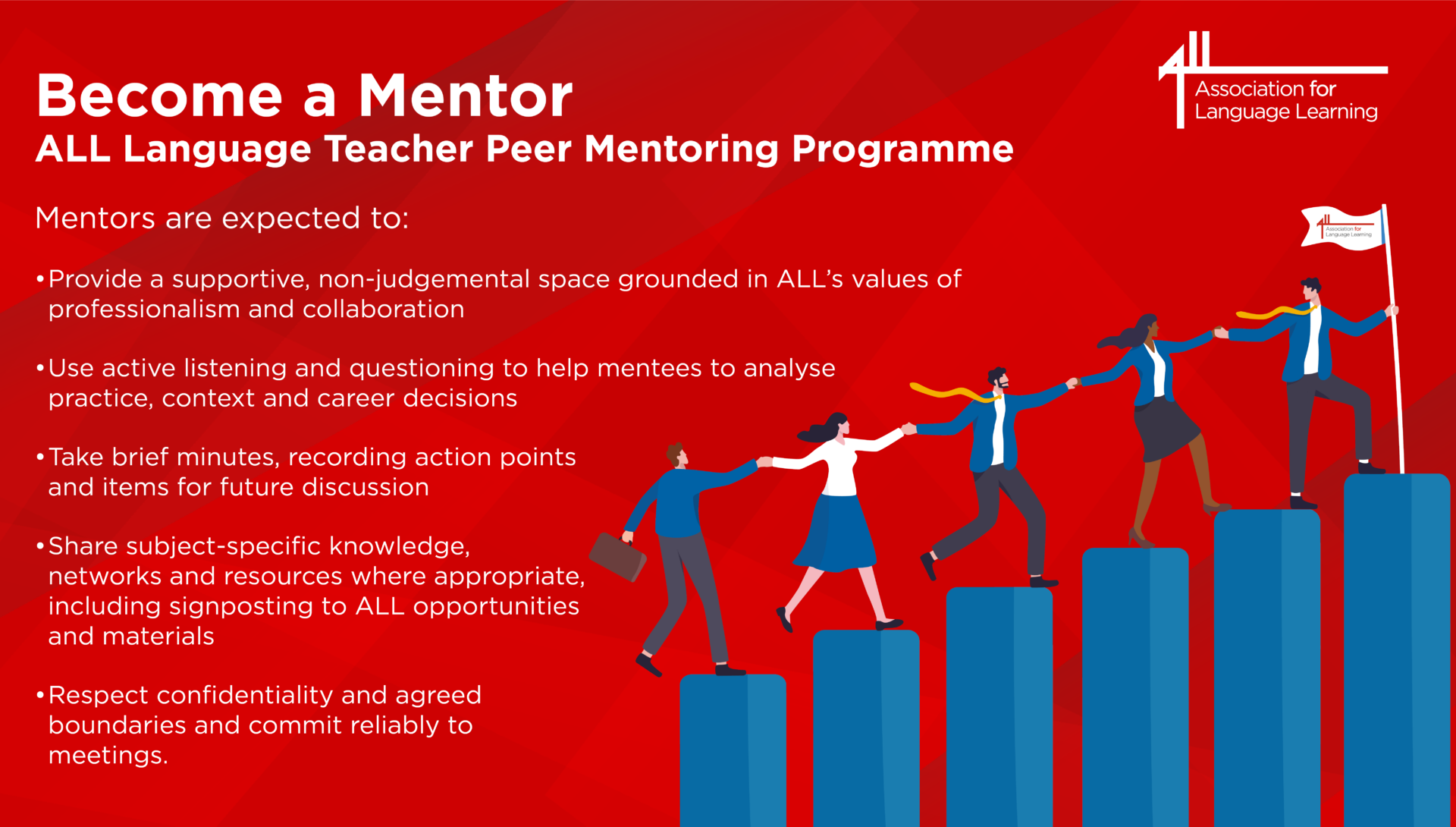
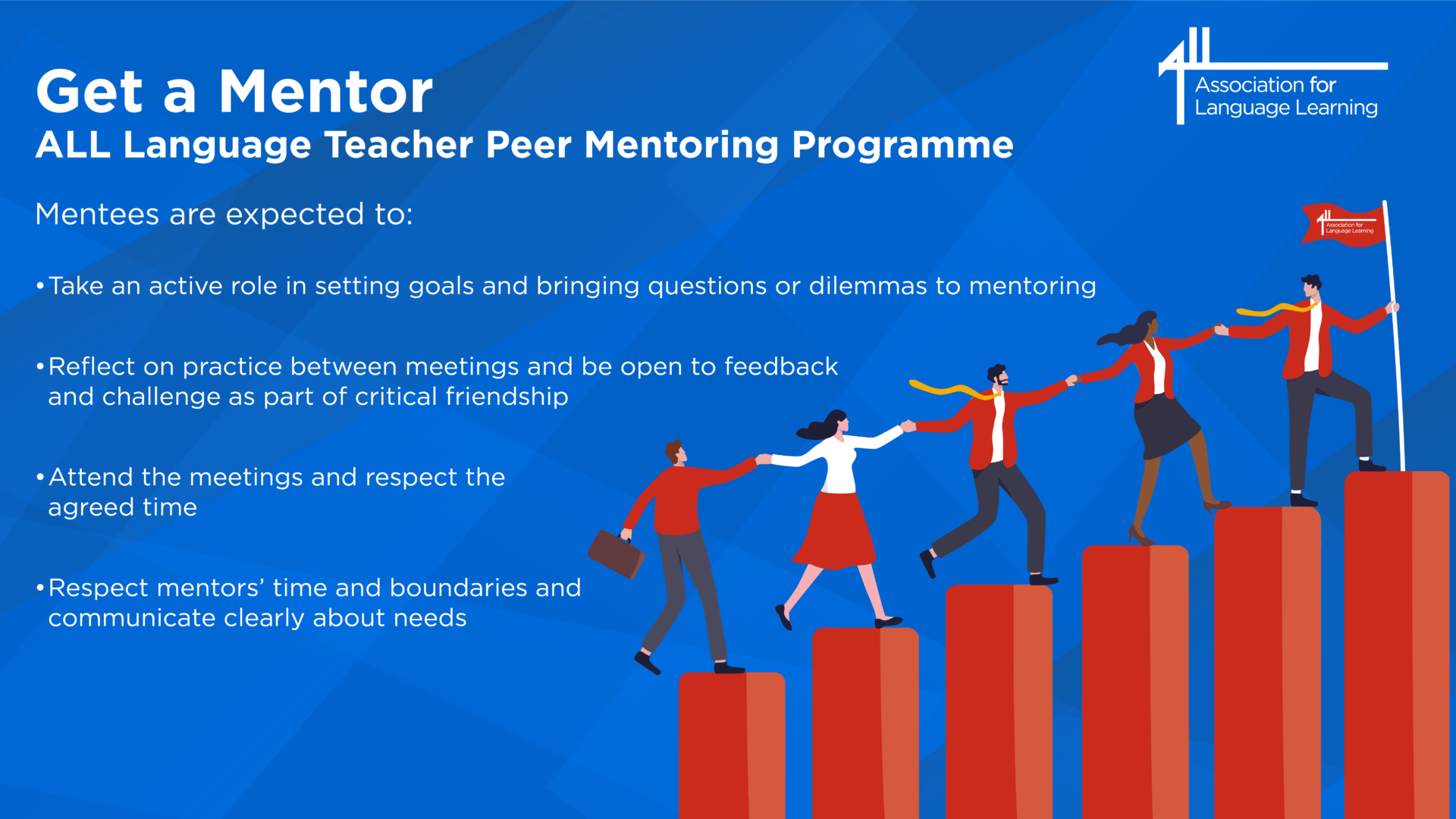
ALL and Branches
- The ALL Peer Mentoring Coordination Group manages recruitment, matching, induction, mentoring circles and evaluation, and ensures alignment with ALL’s broader work and advocacy. They provide support and guidance for both mentors and mentees.
- Following a briefing by the ALL Peer Mentoring Coordination Group, it is anticipated that ALL branches, regional groups and others (e.g. ITET Forum) promote the programme locally and may host in‑person networking or reflection opportunities to complement mentoring.
6. Ethics, Safeguarding and Data
- The programme is developmental and voluntary; it is clearly separated from performance management, capability or formal appraisal processes, in line with ALL’s status as an independent professional Association.
- Safeguarding and professional codes within participants’ institutions remain paramount; mentors encourage colleagues to follow local procedures for any safeguarding or serious professional concerns.
- ALL handles participant data securely (GDPR) and in line with its governance arrangements; evaluation reports are anonymised and used to improve the programme and strengthen the case for better support for language teachers.