Language learning is continuing to decline with many schools cutting down further
Schools began to scale back their language provision after plans to withdraw the EBacc were announced, sparking fears that the change is “squeezing languages out of the picture”. The government said last November it would scrap the EBacc as part of its response to the curriculum and assessment review.
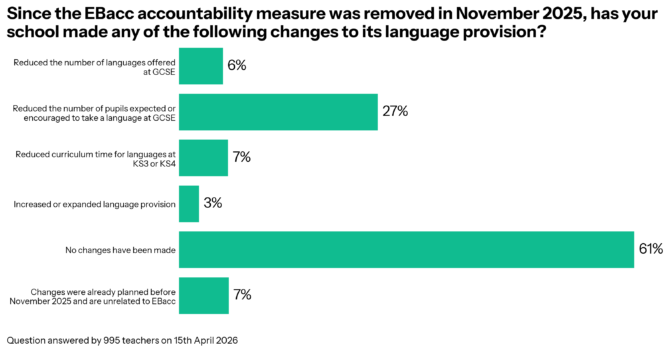
Some leaders welcomed the news, arguing the measure stifled creative subjects, but others are concerned it will leave languages in a vulnerable position. A survey by Teacher Tapp for Schools Week found 29 per cent of respondents reported their schools had cut down on languages provision since November’s announcement.
A survey by Teacher Tapp for Schools Week found 29 per cent of respondents reported their schools had cut down on languages provision since November’s announcement.
The polling suggests 7 per cent of schools have reduced curriculum time for languages at key stages 3 or 4, while 6 per cent have reduced the number of languages they offer at GCSE.
Just 3 per cent of schools expanded their language provision, and 7 per had planned to make changes before November last year.
Disadvantaged pupils worse off
Professor René Koglbauer, a trustee of the Association for Language Learning, said the association was “hearing from more members than ever who are deeply concerned” about decisions “that are squeezing languages out of the picture”.
“Some of these changes will hit GCSE uptake as early as September, with the longer‑term impact becoming visible over the next few years.”
The data also suggests disadvantaged students are slightly more likely to be affected.
Thirty-five per cent of respondents from schools with high free school meals (FSM) eligibility reported cuts, decreasing to 26 per cent of those with low FSM rates.
Schools with the highest number of FSM pupils were also three times more likely to reduce the number of languages offered at GCSE, with 9 per cent doing so.
Private schools were far less likely to reduce their provision, with just 8 per cent reducing the number of pupils expected to take a language at GCSE (compared with 28 per cent of state schools).
They were also more likely to have expanded their language provision (5 per cent), or to have made changes before the EBacc announcement was made (11 per cent).
Primary schools struggle
Pepe Di’Iasio, the general secretary of the leaders’ union ASCL, said the results of the survey were “deeply worrying”, but that the greater underlying issue was the “decline in language learning more generally”.
“Primary schools can struggle to access the specialist language teachers required to foster learning at an early age, while the foreign trips and study programmes that help bring languages alive are being cut due to funding pressures and the cost of living for families.
“On top of this, languages are often perceived as being more challenging subjects to achieve a higher grade at GCSE.
“In order to revitalise languages, we need to develop a funded languages strategy that spans primary and secondary and that is rooted in breaking down barriers to languages and building enthusiasm for these subjects.”
The EBacc, which was introduced by the Conservatives in 2011, measured schools on the proportion of pupils that entered five core subject groups, including one foreign language.
Koglbauer said while the EBacc “initially boosted language uptake”, it declined again after progress 8 was introduced and then stabilised when the 2019 Ofsted framework was established.
Languages ‘squeezed out’
Caroline Voaden, the Liberal Democrat’s education spokesperson and education committee member, said her party had “warned that the government’s curriculum changes would see languages squeezed out”.
“With school budgets now pushed to the brink by Labour’s unfunded commitments, it is no surprise that schools are being forced to make these damaging cuts in the classroom.
“A world-class education must include languages. By settling for a narrow curriculum, this government is failing to prepare students for the global world they will enter.”
The Lib Dems previously called for an expanded EBacc that would “elevat[e] arts and creative subjects”.
Cross-bench peer Valerian Freyberg said that while getting rid of the EBacc was good for the arts overall, it carried “a real cost” for languages.
Judith Blake, a government whip and Labour peer, said the government wanted to start at primary level by updating key stage 2 languages and exploring the development of a new flexible languages qualification.
The Department for Education was contacted for comment.
This article was first published by Schools Week April 2026 and you can read it in full on the Schools Week website here.